
A Diet for Women with PCOS and Hashimoto's: How to Eat Every Day?
October 6, 2026 · 14 min read
Do you really have to choose between recommendations for PCOS and a diet for Hashimoto's? When the advice seems contradictory and the list of forbidden products grows, daily eating can become a source of stress instead of support. That is why a diet for a woman with PCOS and Hashimoto's should consider individual needs, not rely on rigid rules and unjustified eliminations.
It's understandable that you want to know what is worth changing and what is a popular recommendation without justification in your situation. There is no single meal plan suitable for every woman with these diagnoses. What matters is the quality of your daily choices, your well-being, test results, and your doctor's recommendations.
In this article, you will find a practical way to compose meals using the principles of the Healthy Eating Plate. You will learn how to approach gluten and dairy without automatically excluding them from your diet and when to seek support from a dietitian or doctor. Without promises of quick changes and the pressure to change everything at once.
Key Takeaways
- A diet for a woman with PCOS and Hashimoto's should consider individual needs, well-being, and medical recommendations, rather than relying on a single universal meal plan.
- Compose meals from a variety of products, combining vegetables and sources of fiber with protein and fats.
- Do not automatically eliminate gluten, dairy, or carbohydrates. Introduce changes when supported by recognized indications or individual tolerance.
- Build your daily menu step by step: consider your needs, choose a meal base, select products, and observe your well-being.
- A dietitian can help tailor your way of eating, and a doctor is responsible for diagnostics and treatment. Introduce changes without the pressure of immediate results.
Table of Contents
- PCOS and Hashimoto's Simultaneously: Where to Start with Diet Planning?
- Diet for PCOS and Hashimoto's: Principles That Can Connect Both Diagnoses
- Should You Give Up Gluten, Dairy, or Carbohydrates with PCOS and Hashimoto's?
- How to Create a Daily Meal Plan for PCOS and Hashimoto's Step by Step?
- How to Implement a Diet for PCOS and Hashimoto's While Considering Medical Care?
PCOS and Hashimoto's Simultaneously: Where to Start with Diet Planning?
With two diagnoses, it is easy to think you need two separate meal plans and a long list of prohibitions. This does not have to be the starting point. PCOS, or polycystic ovary syndrome, is associated with hormonal imbalances and can affect, among other things, the menstrual cycle and metabolism. Hashimoto's is an autoimmune inflammation of the thyroid. Each of these diagnoses requires an individual assessment, but their co-occurrence does not automatically mean that two restrictive diets are necessary.
What does the co-occurrence of PCOS and Hashimoto's mean?
Each of these conditions has separate diagnostic criteria and can have a different course. With PCOS, irregular periods may occur, among other things, and Hashimoto's can be associated with thyroid dysfunction. The symptoms and their impact on daily well-being vary among individuals. You can read more about the course of this diagnosis in the overview of Hashimoto's disease.
Co-occurrence does not mean that one condition is the direct cause of the other. Therefore, your way of eating should be considered in the context of your symptoms, test results, treatment, and daily needs. The name of the diagnosis alone is not enough to establish individual recommendations.
What role can daily nutrition play?
Varied, balanced meals can support overall health and make it easier to maintain a quality diet. This is a good common foundation, regardless of whether the next steps concern PCOS, thyroid function, or both. You do not have to change your entire menu right away. Start by looking at how you eat every day and what might be missing from your meals.
General principles can be a starting point, but detailed recommendations depend on your situation. They take into account, among other things, test results, ongoing treatment, product tolerance, and preferences. A dietitian can help tailor a nutrition plan to your needs, while a doctor assesses your health and manages treatment.
A diet for a woman with PCOS and Hashimoto's can support daily health, but it does not replace diagnostics, treatment, or medical care. Start with a calm assessment of your needs instead of imposing two sets of restrictions on yourself.
Diet for PCOS and Hashimoto's: Principles That Can Connect Both Diagnoses
With two diagnoses, common foundations are more useful than two separate meal plans. Focus on variety, regular meals, and products that suit your health status, preferences, and lifestyle. There is no single popular nutritional model that must work for every woman.
How to compose a meal to be satisfying and varied?
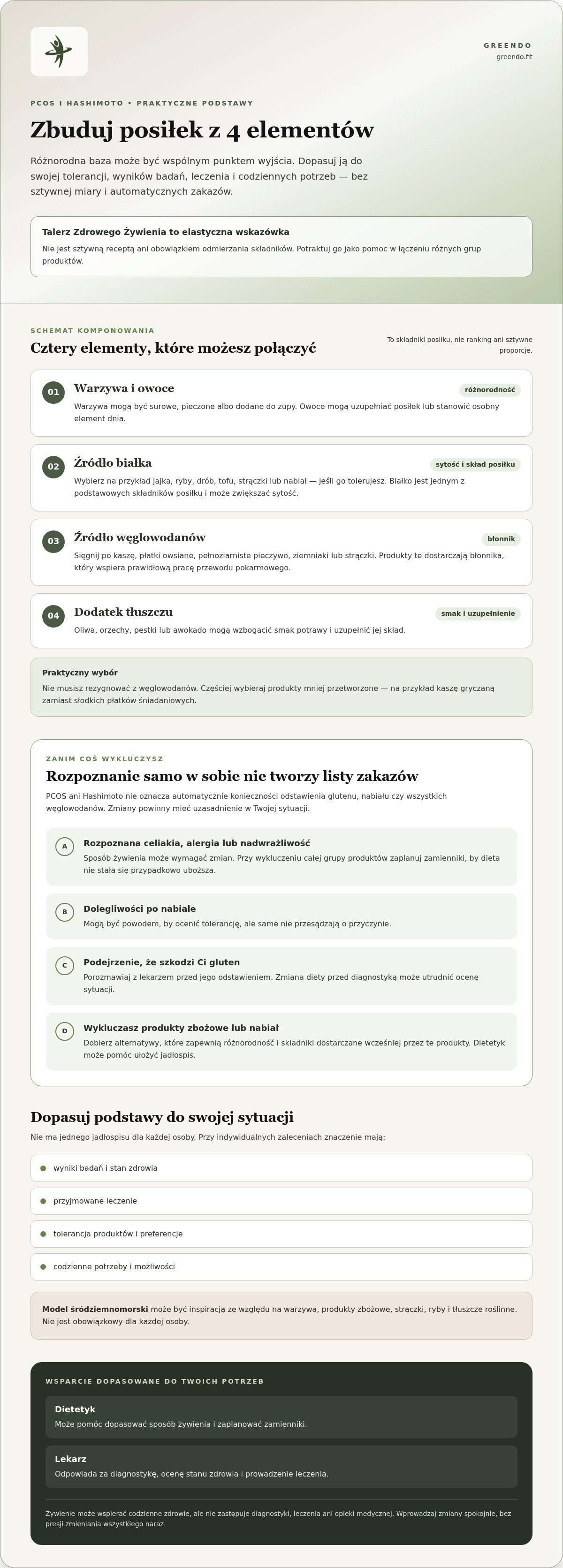
The Healthy Eating Plate is a helpful reference point. Treat it as a flexible guideline, not a rigid prescription or an obligation to measure ingredients. In practice, you can build a meal from several elements:
- Vegetables, for example, roasted, raw, or added to a soup. Fruits can supplement a meal or be a separate part of the day.
- A source of protein, such as eggs, fish, poultry, tofu, legumes, or dairy if you tolerate it. Protein can increase the satiety of a meal and is one of its basic components. You can read more about its role in the article on protein for women.
- A source of carbohydrates, for example, groats, oatmeal, whole-grain bread, potatoes, or legumes. These products provide fiber, which supports the proper functioning of the digestive tract.
- A fat supplement, such as olive oil, nuts, seeds, or avocado. It enriches the taste of the dish and completes its composition.
You do not have to give up carbohydrates. Pay attention to their source and more often choose less processed products, for example, buckwheat groats instead of sweet breakfast cereals. Detailed nutritional recommendations for PCOS are published by the National Center for Nutrition Education (PL).
Is there one best nutritional model for PCOS and Hashimoto's?
You do not have to choose a diet just because it is popular. The Mediterranean model can be an inspiration due to its variety of vegetables, grain products, legumes, fish, and sources of plant-based fats, but it is not mandatory for everyone. Adjust your way of eating to your product tolerance, test results, treatment, and your own capabilities. If you need an individual plan, learn about support in tailoring your nutrition.
Should You Give Up Gluten, Dairy, or Carbohydrates with PCOS and Hashimoto's?
No, a diagnosis of PCOS or Hashimoto's alone does not mean that every woman should eliminate gluten, dairy, or all carbohydrates. Elimination may be necessary for a specific health reason, but it should not be based solely on a popular list of prohibitions. First, determine if a particular product is actually causing you a problem and if its exclusion is justified.
Gluten and dairy: when to consider a change?
With celiac disease, an allergy, or a diagnosed sensitivity, your way of eating may require changes. Discomfort after consuming dairy can be a reason to assess your tolerance, but it does not determine the cause on its own. If you suspect that gluten is harming you, talk to your doctor before giving it up. Changing your diet before diagnostics can make it difficult to assess the situation.
Excluding an entire group of products requires planning for substitutes. If you give up dairy, make sure to find other sources of the nutrients it provided. After eliminating grain products, choose alternatives that provide fiber and variety. A dietitian can help you create a meal plan so that the restrictions do not lead to an accidentally impoverished diet.
Carbohydrates, supplements, and popular prohibitions
Carbohydrates are a diverse group of products that do not need to be eliminated entirely. You can more often choose less processed sources, such as groats, oatmeal, whole-grain bread, vegetables, and legumes. Combine them with a source of protein and fat, and consider your entire diet and your needs when planning.
Caution is also important with supplements. Do not choose doses of iodine, selenium, or other ingredients on your own based solely on a diagnosis or internet advice. The need for supplementation depends on your individual situation. Discuss it with your doctor or dietitian, especially if you are taking medications or considering several changes at once.
The diagnosis itself does not determine the need to eliminate products. A diet for a woman with PCOS and Hashimoto's should take into account confirmed indications, food tolerance, and valuable substitutes. If you are planning major restrictions, consult a specialist instead of introducing several prohibitions at once.
How to Create a Daily Meal Plan for PCOS and Hashimoto's Step by Step?
Planning does not have to start with a ready-made meal plan. Choose a simple scheme that considers your daily rhythm and can be flexibly changed. The following examples are for inspiration and are not a therapeutic meal plan or individual medical advice.
A simple scheme for planning meals for the whole day
- Define your needs. Think about what times you usually eat, when you have time to prepare a meal, and how your appetite changes throughout the day. You do not have to adapt to one rigid schedule.
- Choose a meal base. For the main meal, select a source of protein, a vegetable or fruit, and a grain product, potatoes, or legumes. Examples include eggs with bread and vegetables or fish with groats and a salad.
- Choose products you like and tolerate. Oatmeal with yogurt and fruit can be a good breakfast, and tofu with rice and vegetables for dinner. If you are missing one ingredient, replace it with another that fits your preferences and health recommendations.
- Observe your well-being. Note whether the meal rhythm suits you and if the plan is easy to maintain. Notes can help describe your experiences to a doctor or dietitian, but they do not replace tests or professional evaluation.
Include more active days and those when you have less time in your plan. You can prepare a larger portion of groats or roasted vegetables and use them in the next meal. Leave yourself room for choice. If you do not feel like having yogurt on a particular day, reach for another tolerated source of protein.
How to tailor the plan to your own needs?
A diet for a woman with PCOS and Hashimoto's should consider not only the diagnoses but also test results, treatment, product tolerance, activity, appetite, and daily capabilities. If your symptoms change or something worries you, discuss it with a specialist instead of drawing conclusions based on a single meal. You can read more about the individual approach in the article about an individual diet plan for women.
If you want to translate these tips into a plan tailored to your goals and daily life, learn about individual support in nutrition planning.
How to Implement a Diet for PCOS and Hashimoto's While Considering Medical Care?
Dietary changes are easier to maintain when you introduce them gradually. Choose one specific step, such as adding vegetables to dinner or planning a simple breakfast for busy days. See if this change fits into your daily routine. You do not have to expect immediate results or change your entire menu at once.
How to combine eating habits with a doctor's recommendations?
Inform your doctor about significant changes in your diet and supplementation, especially if you are taking medications or considering preparations containing minerals. The doctor conducts diagnostics and treatment, and a dietitian can help tailor your meal plan to your needs. Do not stop taking medications or change their dosage on your own. Nutrition can support overall health, but it does not cure PCOS or Hashimoto's on its own and does not replace medical care.
How to maintain a nutritional plan on a daily basis?
Choose solutions that do not require starting everything from scratch every day. Do your shopping with a short list of basic products, prepare ingredients in advance, and plan a few simple meals that you can modify.
- Keep non-perishable staples on hand, such as groats, oatmeal, legumes, or frozen vegetables.
- Swap ingredients depending on your appetite, availability, and tolerance. Instead of fish, choose another suitable source of protein.
- Write down which solutions make it easier for you to eat regularly and which are difficult to fit into your day.
Observing your well-being can help you notice how you feel with a given meal rhythm, but it does not allow you to determine the cause of symptoms on your own. If something worries you, discuss it with your doctor. A diet for a woman with PCOS and Hashimoto's should consider your preferences and medical recommendations, not the pressure to achieve a specific result quickly.
If you care about a personalized approach to daily choices, discover the VIP Diet Plan, which helps tailor nutrition to individual needs and body goals. This is support in planning, not a substitute for diagnostics or treatment.
Start with small changes tailored to you
With PCOS and Hashimoto's, you do not need to create two separate, restrictive diets. Focus on varied, balanced meals and choose products tailored to your needs, preferences, and medical recommendations. Gluten, dairy, or carbohydrates do not require automatic exclusion if there is no individual indication to do so.
A diet for a woman with PCOS and Hashimoto's can support daily habits, but it does not replace diagnostics or treatment. Introduce changes gradually and observe how they work in your daily rhythm. Discuss any worrying symptoms with your doctor. A dietitian can help translate general principles into a plan that considers your situation and goals.
If you want to approach nutrition more individually, discover the GREENDO VIP Diet Plan. It provides support in tailoring your daily choices to your needs. Start calmly, step by step. Conscious self-care does not require perfection.
Frequently Asked Questions
Do I need to follow a gluten-free diet with PCOS and Hashimoto's?
No, a diagnosis of PCOS or Hashimoto's alone does not automatically mean a recommendation for a gluten-free diet. It may be necessary for celiac disease or a diagnosed gluten sensitivity. If you suspect that gluten is harming you, talk to your doctor before giving it up, as changing your diet can complicate diagnostics. Without a specific indication, you do not have to give up bread or groats containing gluten.
Can I eat dairy with PCOS and Hashimoto's?
Yes, if you tolerate it well and do not have a diagnosed allergy or other indication for elimination. PCOS or Hashimoto's alone does not mean you have to give up milk, yogurt, or cheese. If you experience discomfort after consuming dairy, discuss it with a specialist instead of excluding the entire product group on your own. If you do eliminate it, ensure you find suitable substitutes to keep your diet varied.
How should I compose meals with PCOS and Hashimoto's?
Include vegetables, a source of protein, a carbohydrate source, and a fat supplement in your meal. An example could be groats with fish and vegetables, or eggs with bread and a salad. Treat this structure as a flexible guideline, not a rigid recipe. Choose products that you like, tolerate, and can regularly include in your daily plan.
Can diet cure PCOS or Hashimoto's?
No, diet is not a standalone cure for PCOS or Hashimoto's. Balanced nutrition can support overall health but does not replace diagnostics, medical care, or prescribed treatment. Do not stop taking medications or change their dosage because of a change in your diet. If you are planning significant dietary modifications, discuss them with your doctor or dietitian.
Do I need to limit carbohydrates with Hashimoto's and PCOS?
You do not need to automatically limit all carbohydrates. Pay attention to the type of products and the composition of the entire meal. More often choose, for example, groats, oatmeal, whole-grain bread, vegetables, or legumes, combining them with a source of protein and fat. Individual recommendations may depend on your health and test results, so major changes should be discussed with a specialist.
What supplements should I take for PCOS and Hashimoto's?
There is no single set of supplements suitable for everyone with PCOS and Hashimoto's. The choice of preparations should take into account your individual health situation, test results, diet, and medications. Do not self-administer doses of iodine, selenium, or other ingredients based on popular advice. Discuss supplementation with your doctor or dietitian. Supplements do not replace medications or medical consultation.
Should a nutrition plan for PCOS and Hashimoto's be individual?
Yes, an individual plan makes it easier to consider your needs, preferences, product tolerance, test results, and daily rhythm. A dietitian can help tailor your meals, while a doctor is responsible for diagnostics and treatment. GREENDO offers a VIP Diet Plan to support tailoring nutrition to body goals. It does not replace medical care or a doctor's recommendations.
Frequently Asked Questions
Do I need to follow a gluten-free diet with PCOS and Hashimoto's?
No, a diagnosis of PCOS or Hashimoto's alone does not automatically mean a recommendation for a gluten-free diet. It may be necessary for celiac disease or a diagnosed gluten sensitivity. If you suspect that gluten is harming you, talk to your doctor before giving it up, as changing your diet can complicate diagnostics. Without a specific indication, you do not have to give up bread or groats containing gluten.
Can I eat dairy with PCOS and Hashimoto's?
Yes, if you tolerate it well and do not have a diagnosed allergy or other indication for elimination. PCOS or Hashimoto's alone does not mean you have to give up milk, yogurt, or cheese. If you experience discomfort after consuming dairy, discuss it with a specialist instead of excluding the entire product group on your own. If you do eliminate it, ensure you find suitable substitutes to keep your diet varied.
How should I compose meals with PCOS and Hashimoto's?
Include vegetables, a source of protein, a carbohydrate source, and a fat supplement in your meal. An example could be groats with fish and vegetables, or eggs with bread and a salad. Treat this structure as a flexible guideline, not a rigid recipe. Choose products that you like, tolerate, and can regularly include in your daily plan.
Can diet cure PCOS or Hashimoto's?
No, diet is not a standalone cure for PCOS or Hashimoto's. Balanced nutrition can support overall health but does not replace diagnostics, medical care, or prescribed treatment. Do not stop taking medications or change their dosage because of a change in your diet. If you are planning significant dietary modifications, discuss them with your doctor or dietitian.
Do I need to limit carbohydrates with Hashimoto's and PCOS?
You do not need to automatically limit all carbohydrates. Pay attention to the type of products and the composition of the entire meal. More often choose, for example, groats, oatmeal, whole-grain bread, vegetables, or legumes, combining them with a source of protein and fat. Individual recommendations may depend on your health and test results, so major changes should be discussed with a specialist.
What supplements should I take for PCOS and Hashimoto's?
There is no single set of supplements suitable for everyone with PCOS and Hashimoto's. The choice of preparations should take into account your individual health situation, test results, diet, and medications. Do not self-administer doses of iodine, selenium, or other ingredients based on popular advice. Discuss supplementation with your doctor or dietitian. Supplements do not replace medications or medical consultation.
Should a nutrition plan for PCOS and Hashimoto's be individual?
Yes, an individual plan makes it easier to consider your needs, preferences, product tolerance, test results, and daily rhythm. A dietitian can help tailor your meals, while a doctor is responsible for diagnostics and treatment. GREENDO offers a VIP Diet Plan to support tailoring nutrition to body goals. It does not replace medical care or a doctor's recommendations.