
A Nutrition Plan for Women Over 40 with Hypothyroidism: A Practical Guide
October 10, 2026 · 16 min read
A nutrition plan for a woman over 40 with hypothyroidism does not have to mean eliminating favorite foods or eating by the clock. If you are over 40, your daily meals might raise questions: what should I choose, how can I fit meals into my work schedule, and do specific products affect my treatment? A good plan should consider your needs, daily rhythm, and medical recommendations.
It is easy to confuse reliable guidance with promises of quick results. Nutrition can support your daily well-being and help you maintain a balanced diet, but it does not replace medical treatment or consultation with a doctor. There is also no single meal plan that is right for every woman.
In this guide, you will find a simple way to compose meals, practical tips for planning your day, and advice on when to tailor your menu individually. No miracle diets, but more clarity and peace in your daily choices.
Key Takeaways
- Combine a variety of products: a source of protein, vegetables or fruits, grain products, and fats.
- Regularity can bring order to your daily eating, but the timing and number of meals should fit your daily rhythm.
- A nutrition plan for a woman over 40 with hypothyroidism does not have to be based on eliminating entire food groups.
- Evaluate popular recommendations carefully. Restrictions and promises of quick results are no substitute for individual guidance.
- An individual plan helps translate general principles into a daily routine and body goals, but it does not replace medical treatment.
Table of Contents
- A nutrition plan for hypothyroidism after 40: what can it support?
- How to compose meals with hypothyroidism without unnecessary restrictions?
- Diet for hypothyroidism: how to evaluate popular recommendations?
- How to create a sample day of eating and tailor it to your needs?
- Individual nutrition plan for hypothyroidism: when is it worth seeking support?
A nutrition plan for hypothyroidism after 40: what can it support?
Information about eating with hypothyroidism can be contradictory. Some sources recommend eliminations, while others argue that changing just one component of your diet is enough. A practical nutrition plan for a woman over 40 with hypothyroidism organizes daily meals, but it is not a method of treatment. It is important to separate daily nutritional support from medical care and to adapt the menu to your individual needs, rather than looking for a single rule for everyone.
What does hypothyroidism mean in the context of nutrition?
Hypothyroidism is a condition in which the gland does not produce enough thyroid hormones. These hormones affect many processes in the body, so a diagnosis is not made based on diet alone or a single observation. A brief overview of information about hypothyroidism can help you understand the topic, but diagnosis and monitoring are conducted by medical staff based on a health assessment and appropriate tests.
Nutrition can support daily well-being and the nutritional quality of meals. However, it does not replace medication or the recommendations of your healthcare provider. Your needs may depend on factors such as test results, overall health, and the treatment you are receiving. Therefore, a universal list of permitted and forbidden products is no substitute for individual advice.
Do you need a separate diet after the age of 40?
Being over 40 does not mean that every woman needs the same meal plan. We differ in our activity levels, appetites, health conditions, preferences, and daily schedules. Daily needs can change, but this does not mean there is one special plan suitable for all women over forty. The most important thing is to tailor your eating habits to your specific situation.
When planning meals, it is helpful to distinguish between two issues:
- Medical care includes diagnosis, health monitoring, and determining treatment. Discuss any doubts about tests or medications with your doctor.
- Nutrition planning organizes your daily choices, taking into account your preferences, daily rhythm, and goals. It should be practical, not a source of more restrictions.
You do not have to follow a rigid scheme just because you are over 40 and have hypothyroidism. Start by assessing how you eat, when you have time for meals, and what solutions are realistic for you. A good framework helps you make informed decisions, while individual medical recommendations remain the responsibility of a specialist. This way, you can treat nutrition as a support, not a therapy.
How to compose meals with hypothyroidism without unnecessary restrictions?
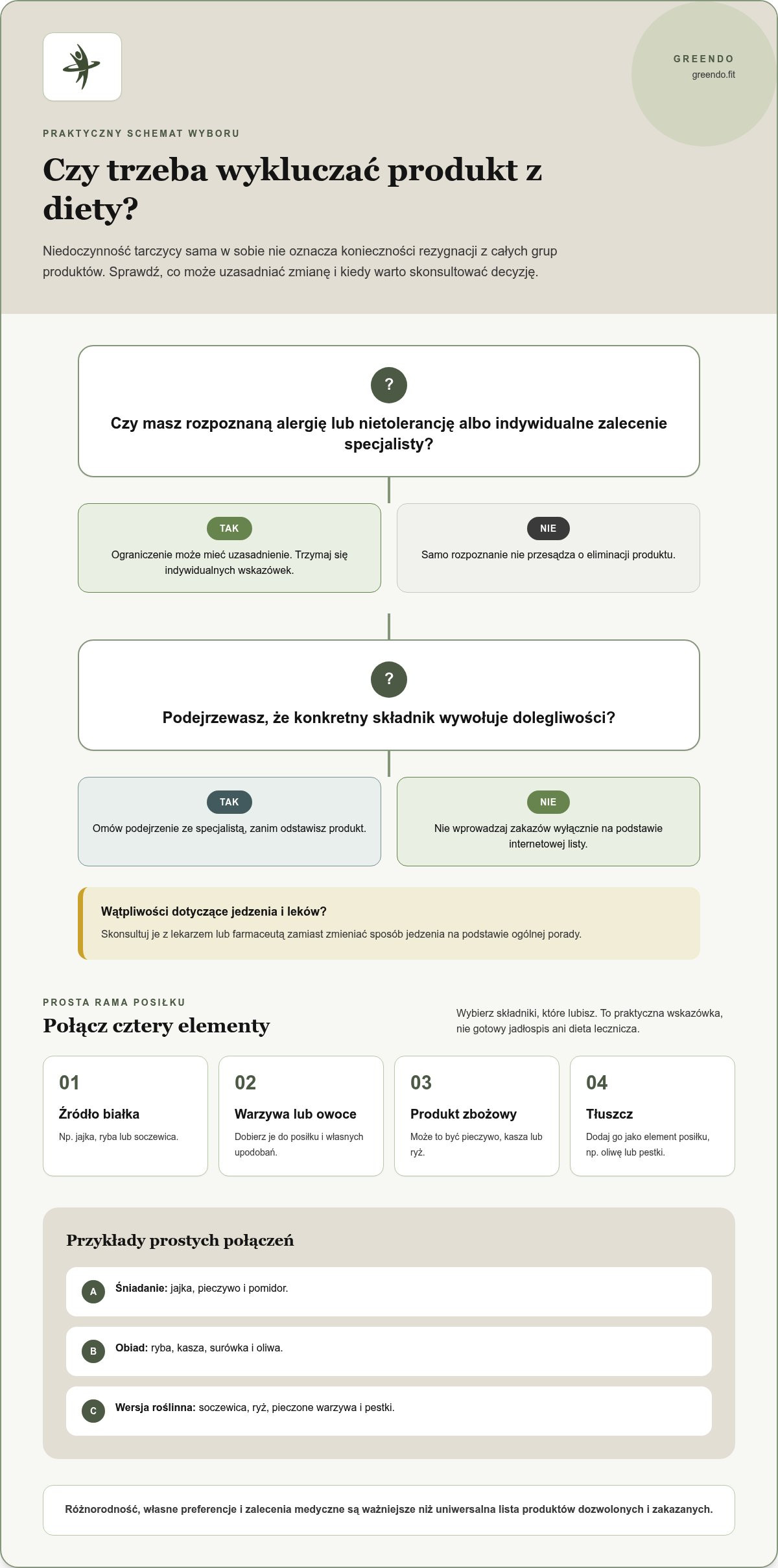
A practical starting point is to combine several elements: a source of protein, vegetables or fruits, grain products, and fat. You do not need to measure ingredients with pharmaceutical precision. Treat this framework as a guide when choosing products and adapt it to your appetite, available ingredients, and personal preferences. A balanced menu is not a therapeutic diet.
How to build a balanced plate for everyday meals?
Choose ingredients you like and combine them into a simple meal. For breakfast, you could have eggs with bread and tomato, and for lunch, fish with groats, a side salad, and olive oil. A plant-based option could be a bowl with lentils, rice, roasted vegetables, and seeds. These are inspirations for daily cooking, not a ready-made meal plan or individual recommendations.
Variety is easier to maintain when you change ingredients instead of looking for one perfect set. Choose seasonal vegetables, different grain products, and protein sources that suit your tastes. You can also prepare some ingredients in advance, such as cooking groats or chopping vegetables. This will help you compose a meal more quickly on a busy day.
Do not impose a specific number of meals or rigid times on yourself. Think about when you usually have a break, feel hungry, and can eat peacefully. On one day, larger meals might be more convenient, while on another, you might add a snack. Observe what schedule is practical and allows you to eat regularly without pressure.
Do you need to exclude specific products with hypothyroidism?
Do not assume that a diagnosis automatically requires you to give up gluten, dairy, or cruciferous vegetables. Elimination may be justified in the case of an allergy, intolerance, or individual recommendation, but it should not be based solely on online lists of forbidden products. Broccoli and cauliflower can be part of a varied menu. If you suspect that an ingredient is causing you problems, discuss it with a specialist before eliminating it.
Discuss any concerns about food and medications with your doctor or pharmacist, instead of changing your eating habits based on general advice. Information from the American Thyroid Association, including their recommendations on hypothyroidism, can help you understand the basics of treatment. Individual decisions should be made with medical personnel.
If you want to translate these principles into a daily routine and body goals, individual nutrition planning can help you organize your meals according to your preferences.
Diet for hypothyroidism: how to evaluate popular recommendations?
A restrictive diet is not an automatic requirement for every diagnosis of hypothyroidism. Before you try a method you found online, check if it provides a specific justification, explains its limitations, and does not present one meal plan as a solution for everyone. The table below helps distinguish a practical approach from recommendations that should first be discussed with a specialist.
| Approach | Possible practical benefit | Limitations | When consultation is needed |
|---|---|---|---|
| Balanced menu | Facilitates planning varied meals and making daily decisions. | It is not a treatment method or a guarantee of a specific outcome. | When you need to consider body goals, restrictions, or other health needs. |
| Elimination diet | May be appropriate for a specific indication, such as a diagnosed allergy or intolerance. | Unjustified exclusions can narrow your choice of products and make it difficult to compose meals. | Before eliminating products, especially several groups at once. |
| Plan based on unverified promises | May draw attention to habits worth discussing with a specialist. | Promises of rapid weight loss or improved results through diet alone are not proof of effectiveness. | When a recommendation encourages changing treatment, stopping medication, or taking supplements without an individual assessment. |
How to recognize unjustified dietary promises?
Be wary of messages promising rapid weight loss, "unblocking" the thyroid, or normalizing results with a single product. Such slogans often overlook individual differences and do not explain the evidence they are based on. Reliable advice does not guarantee a specific effect or suggest that you can self-diagnose or change your treatment.
Before starting an elimination or supplementation, ask your doctor or a dietitian if there is a justification for it in your situation. It is especially important to consult about several restrictions at once, such as excluding gluten, dairy, and soy, which can significantly change your daily menu.
Treatment, levothyroxine, and food: what requires individual advice?
Levothyroxine is a medication, not a part of your menu. The way it is used and possible interactions with food or supplements should be determined with your doctor or pharmacist. Do not apply general guidelines to your own therapy without verification, and do not change the dose or time of taking the medication based on dietary advice.
A popular recommendation can be a starting point for a conversation, not a ready-made instruction. When choosing a nutrition plan for a woman over 40 with hypothyroidism, be guided by practicality and reliable justification. Treat promises of quick results as a signal for closer verification.
How to create a sample day of eating and tailor it to your needs?
Treat a sample day plan as a draft that you can change. There is no single correct number of meals or universal portion sizes. Look at when you feel hungry, what your schedule is like, and how much time you have to prepare food. These observations will help you create a plan that works in practice, not just on paper.
Five steps to a practical meal plan
- Write down your daily schedule. Include when you wake up, work, commute, exercise, and rest. Mark when you have a quiet break for a meal.
- Determine what you like and what you need. Write down your favorite dishes, products you avoid, and situations where you find it hardest to stick to your plan.
- Arrange meals throughout the day. For example: breakfast before leaving or taken with you, a meal during a work break, a snack if it fits your appetite, and dinner after returning. Adjust the layout to your own rhythm.
- Prepare a shopping list. Choose varied, well-liked ingredients for meals that you can actually prepare. Plan a base for a few days and change the extras for variety.
- Evaluate the convenience of the plan. After a few days, check if the times were realistic, the meals easy to prepare, and the shopping list useful. Change what makes the plan difficult to use.
A sample daily structure that you can change
If you lack time in the morning, prepare breakfast the evening before or choose ingredients that are easy to pack. At work, plan a break for your main meal, and include a snack when it suits your appetite. In the evening, choose a simple dish or a previously prepared meal. Adjust portions to yourself instead of copying quantities from a sample menu.
How to modify your menu when your needs change?
A change in work hours, more activity, or a different appetite may require shifting meals or preparing different ingredients. Write down what helps you feel good and what makes it difficult to follow the plan. If you notice any concerning or persistent changes in your well-being, discuss them with medical personnel. For co-existing diseases, dietary restrictions, or questions about test results, it is worth discussing individual adjustments with a dietitian.
If you want to organize your meals around your daily rhythm and body goals, discover the VIP Diet Plan, which is individual help in nutrition planning.
Individual nutrition plan for hypothyroidism: when is it worth seeking support?
General guidelines are a good starting point, but they are not always easy to translate into your own week. If you find it difficult to plan meals around work, activity, appetite, and body goals, individual support can help you organize your daily choices. A nutrition plan for a woman over 40 with hypothyroidism should take into account her situation and preferences, not be based on a ready-made scheme for everyone.
Before planning a menu, think about what causes you the most difficulty: a lack of ideas for meals, an irregular daily rhythm, dietary restrictions, or achieving body goals. Specific examples from everyday life will make it easier to translate general principles into practical solutions. If you are under medical care for hypothyroidism, inform your dietitian about the diagnosis and any restrictions you follow. Nutrition planning should take this knowledge into account, but not replace your doctor's instructions.
What to consider in individual nutrition planning?
A personalized menu should be based on your preferences, daily routine, activity, and body goals. Your ability to prepare meals and the products you like and are happy to include in your diet are also important. If you have allergies, intolerances, or other restrictions, provide this information to your dietitian. This will make it easier to choose solutions that fit your daily life, instead of creating a plan that is difficult to maintain.
GREENDO offers the VIP Diet Plan, an individually tailored nutrition program that supports body goals. It helps organize meals and translate assumptions into a daily routine. It is not a therapy for hypothyroidism, and the menu itself will not cure the disease or guarantee a change in test results.
How to combine a nutrition plan with medical care?
A dietitian supports the organization of nutrition, while a doctor diagnoses and treats hypothyroidism. Direct questions about tests, medication dosage, the timing of their intake, or possible interactions with food and supplements to your doctor or pharmacist. Do not change your therapy based on a meal plan or content found on the internet.
An individual approach does not have to mean complicated rules. It helps you find meals and a rhythm that suit your preferences and goals, while adhering to medical recommendations. Choose solutions that you can maintain on a daily basis. If you want to organize your nutrition with your body goals in mind, discover GREENDO's individual nutritional support.
Start with a step that fits your life
You do not have to change your entire way of eating at once. Choose one thing you can realistically introduce, such as planning a meal for a busy day or preparing ingredients the evening before. A feasible step allows you to see what fits into your daily life and gradually build your own rhythm.
A good nutrition plan for a woman over 40 with hypothyroidism should not be another source of pressure. It should support informed decisions and take your needs into account, leaving treatment issues in the care of medical personnel. Well-organized guidance can make it easier to put principles into practice.
Discover the GREENDO VIP Diet Plan and organize your nutrition with your body goals in mind. Start calmly, with kindness towards yourself. Every lasting habit has a beginning.
Frequently Asked Questions
Is there a special diet for hypothyroidism for women over 40?
There is no single meal plan suitable for every woman with hypothyroidism. Age, activity, appetite, other health problems, and the treatment used can influence individual needs. A nutrition plan for a woman over 40 with hypothyroidism should be based on varied meals, and specific restrictions or recommendations should be determined individually. If you need more detailed guidance, discuss your menu with a dietitian, taking into account your doctor's recommendations.
Do you need to exclude gluten or dairy with hypothyroidism?
No, a diagnosis of hypothyroidism alone does not mean you need to eliminate gluten or dairy. Elimination may be indicated for a diagnosed celiac disease, allergy, intolerance, or other individual recommendation, but it should not be based solely on an online list of products. If you suspect that a particular ingredient is causing you problems, talk to your doctor before excluding it. Do not start an elimination diet before being tested for celiac disease, as changing your menu can make the assessment difficult.
How to prepare breakfast with hypothyroidism?
Choose a breakfast that combines filling ingredients and suits your appetite. An example could be oatmeal with yogurt and fruit, or sandwiches with an egg and vegetables. These are suggestions, not special therapeutic meals. If you take levothyroxine in the morning, plan your breakfast according to your doctor's recommendations or the medication leaflet, as the timing of your meal can affect its absorption. Do not change the intake schedule on your own.
Is it possible to lose weight with hypothyroidism?
Weight loss may be possible, but its pace and course are individual. Factors such as health status, daily habits, activity, and treatment method are important. If your weight changes despite your efforts or you find it difficult to plan your meals, talk to your doctor and a dietitian. Together you can assess the situation and set realistic actions. Avoid fasting and promises that a specific product will speed up weight loss on its own.
Is supplementation with iodine or selenium necessary for hypothyroidism?
Not everyone needs iodine or selenium supplements. The justification for supplementation depends on your individual health situation, diet, and specialist recommendations. Do not take these ingredients "for the thyroid" without consultation: an excess can also be harmful, and a supplement does not replace treatment. Discuss any supplements you take with your doctor or pharmacist, especially if you are on medication or plan to change your dose. The choice and dosage should be based on an individual assessment.
Can levothyroxine be taken with breakfast?
Usually, levothyroxine is taken on an empty stomach, and breakfast is eaten after the recommended interval. Food can change the absorption of the drug. The exact method of use depends on the doctor's recommendations and the leaflet of the specific preparation, so do not move the dose or combine it with breakfast without advice. If the morning schedule is difficult to fit into your day, ask your doctor or pharmacist for a safe solution. Stick to the prescribed way of taking the medication.
Can an individual nutrition plan replace treatment for hypothyroidism?
No, a nutrition plan does not replace treatment for hypothyroidism. Its role is to help organize meals and adapt them to your daily life and body goals. Diagnosis, follow-up tests, and decisions about medications are part of medical care. If you are using an individual plan, inform your dietitian about your diagnosis and restrictions, and discuss therapy recommendations with your doctor. Do not stop or change your medication based on a meal plan.
Frequently Asked Questions
Is there a special diet for hypothyroidism for women over 40?
There is no single meal plan suitable for every woman with hypothyroidism. Age, activity, appetite, other health problems, and the treatment used can influence individual needs. A nutrition plan for a woman over 40 with hypothyroidism should be based on varied meals, and specific restrictions or recommendations should be determined individually. If you need more detailed guidance, discuss your menu with a dietitian, taking into account your doctor's recommendations.
Do you need to exclude gluten or dairy with hypothyroidism?
No, a diagnosis of hypothyroidism alone does not mean you need to eliminate gluten or dairy. Elimination may be indicated for a diagnosed celiac disease, allergy, intolerance, or other individual recommendation, but it should not be based solely on an online list of products. If you suspect that a particular ingredient is causing you problems, talk to your doctor before excluding it. Do not start an elimination diet before being tested for celiac disease, as changing your menu can make the assessment difficult.
How to prepare breakfast with hypothyroidism?
Choose a breakfast that combines filling ingredients and suits your appetite. An example could be oatmeal with yogurt and fruit, or sandwiches with an egg and vegetables. These are suggestions, not special therapeutic meals. If you take levothyroxine in the morning, plan your breakfast according to your doctor's recommendations or the medication leaflet, as the timing of your meal can affect its absorption. Do not change the intake schedule on your own.
Is it possible to lose weight with hypothyroidism?
Weight loss may be possible, but its pace and course are individual. Factors such as health status, daily habits, activity, and treatment method are important. If your weight changes despite your efforts or you find it difficult to plan your meals, talk to your doctor and a dietitian. Together you can assess the situation and set realistic actions. Avoid fasting and promises that a specific product will speed up weight loss on its own.
Is supplementation with iodine or selenium necessary for hypothyroidism?
Not everyone needs iodine or selenium supplements. The justification for supplementation depends on your individual health situation, diet, and specialist recommendations. Do not take these ingredients "for the thyroid" without consultation: an excess can also be harmful, and a supplement does not replace treatment. Discuss any supplements you take with your doctor or pharmacist, especially if you are on medication or plan to change your dose. The choice and dosage should be based on an individual assessment.
Can levothyroxine be taken with breakfast?
Usually, levothyroxine is taken on an empty stomach, and breakfast is eaten after the recommended interval. Food can change the absorption of the drug. The exact method of use depends on the doctor's recommendations and the leaflet of the specific preparation, so do not move the dose or combine it with breakfast without advice. If the morning schedule is difficult to fit into your day, ask your doctor or pharmacist for a safe solution. Stick to the prescribed way of taking the medication.
Can an individual nutrition plan replace treatment for hypothyroidism?
No, a nutrition plan does not replace treatment for hypothyroidism. Its role is to help organize meals and adapt them to your daily life and body goals. Diagnosis, follow-up tests, and decisions about medications are part of medical care. If you are using an individual plan, inform your dietitian about your diagnosis and restrictions, and discuss therapy recommendations with your doctor. Do not stop or change your medication based on a meal plan.