
Supplementation for Women in Perimenopause: How to Choose Mindfully?
October 9, 2026 · 17 min read
What if the first step in perimenopause was not choosing a supplement, but looking at your own needs? Supplementation for women in perimenopause should not start with the promises on the packaging. Changes in your well-being or cycle rhythm can raise questions, and conflicting recommendations make it difficult to assess what is important for you.
It is understandable that you want to take care of yourself, but you do not know where to start. Supplementation needs are individual. They depend on, among other things, your diet, health status, medications you take, and any deficiencies. A dietary supplement complements your daily menu, but it does not replace medical treatment or a health consultation.
In this article, you will find practical tips on how to prepare for a conversation with a doctor or dietitian and how to evaluate the composition and information about a product. You will also learn what to watch out for when combining supplements with medications and other preparations. This will make it easier for you to make a decision based on your needs, not on an excess of promises.
Key Takeaways
- Supplementation for women in perimenopause should stem from individual needs, not from the stage of life itself.
- Write down observations about your well-being and diet, then discuss them with a specialist.
- When comparing products, check the ingredients, recommended serving, and warnings. The popularity of an ingredient does not mean you need it.
- Before incorporating a supplement, read the label, consider other preparations you are taking, and observe your tolerance.
- Forever Young combines whey protein isolate with bovine collagen hydrolysate. Assess whether the other ingredients and the entire formula fit your diet and goals.
Table of Contents
- What is perimenopause and why are supplementation needs individual?
- How to assess your body's needs in perimenopause before choosing a supplement?
- How to compare ingredients and the quality of evidence in supplements for women?
- How to safely incorporate supplementation into your daily diet?
- How to fit Forever Young into mindful supplementation in perimenopause?
What is perimenopause and why are supplementation needs individual?
A change in your menstrual rhythm may prompt questions, but it does not determine the cause on its own. Perimenopause is a transitional period in which the body gradually approaches menopause, and the cycle and well-being may change. Menopause means the last menstrual period, which is recognized retrospectively, after twelve months without bleeding. You can find more information in the article What is perimenopause?.
Definition to quote: Perimenopause is the transitional period before and around menopause, which may be accompanied by changes in the menstrual cycle and well-being.
Perimenopause is different for every woman. Hormonal changes can affect the regularity of periods, and some women also notice differences in sleep, mood, or how they experience heat. The type and intensity of these changes vary, and some women do not experience distinct symptoms. Therefore, do not attribute every change to perimenopause or choose supplements solely on this basis.
How to understand changes in your cycle and well-being?
Keep a record of what changes and when. Note the date of your period, the nature of the bleeding, and any new or recurring ailments. Such a note does not replace a diagnosis, but it makes it easier to describe the situation during a consultation. Similar symptoms can have different causes, so do not assume that every change is due to perimenopause. If symptoms are new, severe, or concerning, consult your doctor.
Why doesn't one list of supplements fit every woman?
It is not just about your stage of life and well-being. Your diet, test results, health status, medications, and daily activity also matter. A person whose diet provides a sufficient amount of a given ingredient may have different needs than a person in whom a specialist has diagnosed a deficiency. Supplementing a confirmed deficiency is different from taking an ingredient without an established need.
Therefore, supplementation for women in perimenopause should address a specific goal, not the promise of a one-size-fits-all solution. Dietary supplements are meant to complement a normal diet. They do not diagnose the causes of changes or treat symptoms. Before choosing a product, consider what you need and whether its composition fits your diet, health status, and medications. A mindful choice starts with context, not the label.
How to assess your body's needs in perimenopause before choosing a supplement?
Before you choose a preparation, organize information about your well-being and daily habits. This will make it easier to distinguish a general goal, such as supplementing your diet, from an attempt to self-alleviate symptoms. A symptom alone does not determine a deficiency of a specific ingredient. Similar ailments can have different causes and do not automatically indicate which supplement you need.
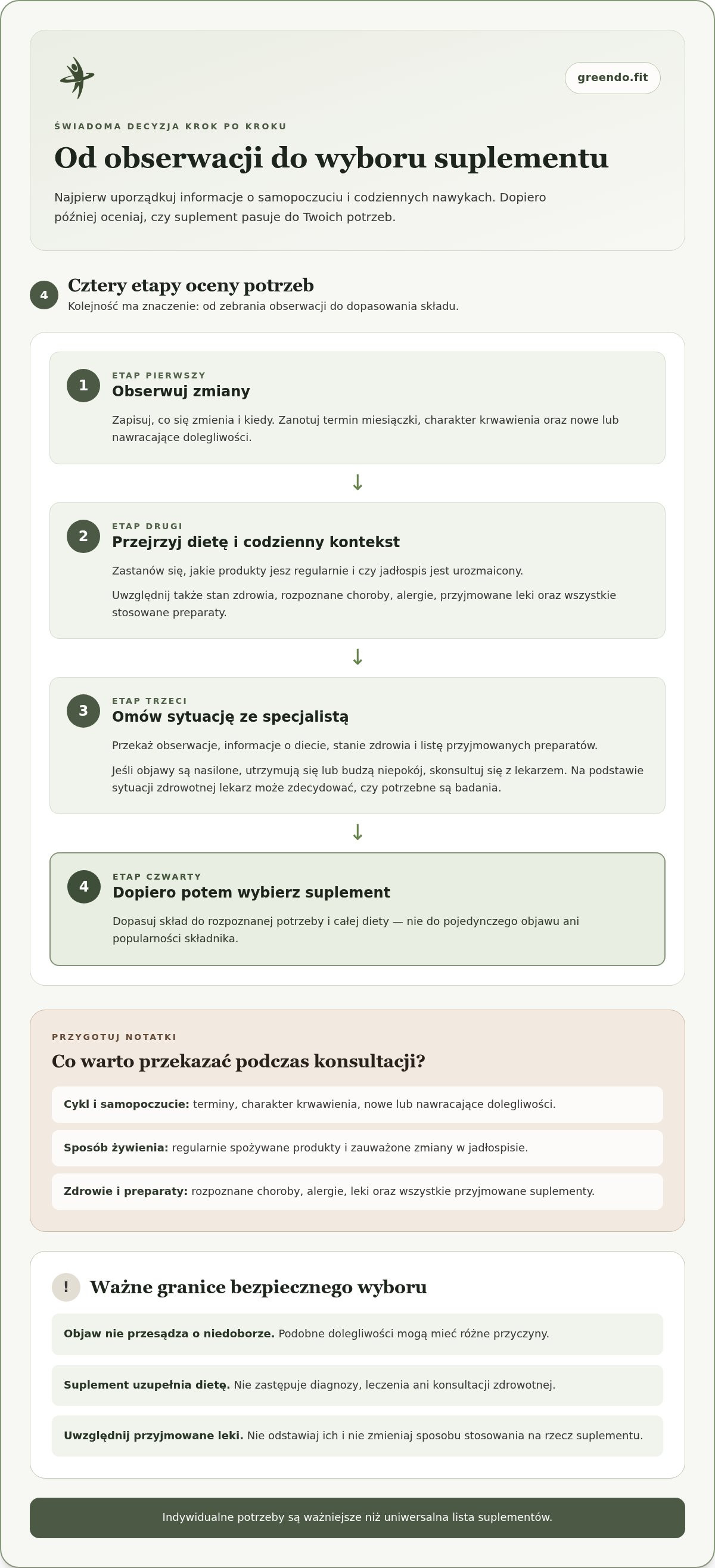
Treat the needs assessment as a simple process:
- Observe. Write down the changes you notice and the circumstances in which they appear.
- Review your diet. Think about what products you eat regularly and whether your menu is varied.
- Discuss the situation with a specialist. Provide them with your observations, information about your health, and a list of preparations you take.
- Only then choose a supplement. Match the composition to the identified need and your entire diet, not to a single symptom.
What is worth noting before talking to a specialist?
Prepare brief notes about your cycle, well-being, diet, and all the preparations you take, including supplements. Include diagnosed diseases, allergies, and medications you use. You do not have to assess what individual changes mean on your own. Specific examples, such as a missed period, a new ailment, or a change in your diet, will help the specialist understand the context.
When is a consultation needed instead of a self-selection?
Consult a doctor when symptoms are severe, persistent, or concerning. A conversation is especially important if you have a chronic disease or take medication. The choice of a supplement should take into account the entire picture of your health. Information about diagnosis and management in perimenopause is also described by the Mayo Clinic.
Based on the interview and symptoms, the doctor may decide whether tests are needed. Not every woman needs the same tests, and their scope depends on the health situation and the question they are meant to answer. The results may help in choosing the next steps or indicate that it is worth considering another cause of the ailments. Do not choose tests or supplements based solely on a single symptom.
Supplementation for women in perimenopause is intended to complement the diet, not to replace diagnosis or treatment. Do not stop taking medications or change the way you use them in favor of a supplement. If you want to translate your observations into your daily menu, get to know the individual VIP diet plan. First, determine your needs, then choose the solution.
How to compare ingredients and the quality of evidence in supplements for women?
Do not start by asking which ingredient is the most popular. Determine the purpose of its use, whether there are specific grounds for it in your situation, and how strong the available evidence is. Also pay attention to what the research does not confirm. Supplementation for women in perimenopause does not mean one list of ingredients suitable for everyone.
Vitamin D, calcium, and protein can be considered in the context of your entire diet, health status, and individual needs. The name of an ingredient on the label alone does not mean that its additional intake is necessary. Collagen, biotin, or coenzyme Q10 should also not be presented as a way to treat perimenopause. Distinguish between supplementing the diet and promises of influencing symptoms.
Ingredient | Possible context of use | Question for a specialist | Limitations of evidence
Vitamin D | Assessment of supply and individual needs | Is it worth checking its level in my situation? | The need for supplementation depends on the health context and diet.
Calcium | Review of sources in the daily menu | Does my diet provide it in the right amount? | Perimenopause alone does not determine the need for a supplement.
Protein | Assessment of whether the menu provides high-quality protein | Is there enough of it in my menu? | A supplement does not replace a varied diet.
Collagen, biotin, coenzyme Q10 | Considering them in relation to the product's composition and your own goal | Does this composition fit my diet and health status? | Their presence does not mean treatment of perimenopause symptoms.
How to distinguish evidence from marketing promises?
Check if the information pertains to the ingredient itself or to a specific product with a defined composition and serving size. They are not the same. The result of a study on a single ingredient does not automatically prove that a finished supplement will produce the same effect. The results of a product study also do not guarantee the same response in every person. Be cautious of slogans suggesting that a supplement is equivalent to medical therapy.
How does the composition of Forever Young fit into a mindful choice?
Forever Young is GREENDO's flagship product. It contains whey protein isolate, bovine collagen hydrolysate, vitamin C, biotin, and coenzyme Q10. The combination of isolate and collagen is a 2-in-1 formula. This is a description of the composition, not a promise of an effect on hormonal symptoms. Read the information about the composition of Forever Young and assess whether the product suits your diet, goal, and tolerance. A transparent composition makes it easier to evaluate, but it does not replace an individual assessment of needs.
How to safely incorporate supplementation into your daily diet?
Safely using a supplement does not start with adding another product to your morning routine. First, check what your diet provides, then read the label and consider possible risks. This order helps to avoid accidentally combining preparations and choosing ingredients you do not need.
- Check your diet. Write down what you eat regularly and what purpose the supplement is supposed to serve. A guide on diet and supplementation for women can be helpful in matching a preparation to your menu.
- Read the label. Check the ingredients, the serving recommended by the manufacturer, warnings, and information on use. Do not exceed the recommendations on the label or determine the dosage based on others' experiences.
- Discuss possible risks. Consult your choice with a doctor or pharmacist, especially if you take medications, have a chronic disease or allergy, or use several preparations.
- Observe your tolerance. Pay attention to how you feel after incorporating the product. If a concerning reaction appears, talk to a specialist.
How to read a label and avoid duplicating ingredients?
Evaluate supplements together, not each one separately. Compare the labels of all the products you use and check if the same ingredients are not repeated in several formulas, for example, in a multi-ingredient preparation and a separate supplement. Pay attention to the recommended serving on the label and the manufacturer's warnings. If you do not know how to put this information together, ask a specialist for help.
A transparent composition makes it easier to determine what the product contains and to compare it with other preparations. The term Clean Label Formula may describe the simplicity of the composition, but it does not in itself prove effectiveness or suitability for your needs. What matters is the entire label, the purpose of use, and the health context.
How to build a simple daily ritual without excess?
Treat a supplement as a complement to a regular, varied way of eating, not as a meal replacement. If its use is justified, incorporate it into your daily ritual according to the recommendations on the label. Choose a solution that is easy to include in your daily plan and, from time to time, assess whether it still corresponds to your goal. Do not assume immediate changes or guaranteed results. In mindful supplementation, what counts is moderation and attentiveness, not the number of products taken.
This is how it is worth approaching supplementation for women in perimenopause: check the composition, consider your diet, and remember about safety. If you are considering Forever Young as part of your menu, check the product's composition and assess whether it meets your needs. A dietary supplement complements the diet, but it does not replace a consultation or recommended treatment.
How to fit Forever Young into mindful supplementation in perimenopause?
The stage of life alone does not determine the need for a specific supplement. What matters in the choice is diet, goal, health status, and tolerance of ingredients. You can consider Forever Young, GREENDO's flagship product, as a supplement to your menu if its composition fits what you are looking for. It is not a hormonal preparation or a treatment for perimenopause symptoms.
For whom can the 2-in-1 formula be a convenient solution?
Forever Young combines whey protein isolate with bovine collagen hydrolysate. The formula also contains vitamin C, biotin, and coenzyme Q10. This combination may suit a person who wants to include protein and collagen in one supplement. Before choosing, check the full label and assess whether the product fits your diet and tolerance. Pay special attention to the composition if milk proteins are a problem for you.
The mere presence of ingredients does not mean that every woman needs them or that the formula will affect hormonal changes. Compare it with what you already eat and take. If your diet already contains many sources of protein or you use other supplements, include them in your overall assessment. Do not choose a preparation solely because you are in perimenopause.
When evaluating the composition, check the information on the label, including the recommended serving and warnings. The phrase "natural dose of vitamins" does not in itself confirm the origin or quantity of vitamins in the product. Be guided by the information provided on the label. If you have an allergy or a chronic disease, take medication, or do not know how to combine the product with other preparations, discuss your choice with a specialist.
When to focus on consultation and diet first?
If you eat irregularly or do not know if you are getting the necessary ingredients, start by reviewing your menu. Varied meals remain the foundation, and a supplement is meant to complement them, not replace them. You will find a broader context of daily choices in the guide on mindful supplementation for the active woman.
A conversation with a doctor or dietitian is especially important if you take medications, have a chronic disease, or have concerning ailments. A supplement does not replace a diagnosis, recommended treatment, or individual nutritional assessment. Base your choice on a specific goal and your own comfort, not on the assumption that one product will be right for everyone.
If you want to assess whether the composition meets your needs, familiarize yourself with the information about Forever Young. A mindful decision starts with knowledge and fitting the product into your daily life.
Start with one mindful step
You do not have to change your entire daily routine at once. Choose one specific step: organize your menu, write down questions for a specialist, or review the preparations you are already taking. This will make it easier to make decisions without pressure and to assess whether the chosen direction meets your needs.
In perimenopause, it is worth returning to your goals and evaluating supplementation in the context of your health, nutrition, and well-being. Let supplementation for women in perimenopause be a thoughtful complement to daily habits, not another obligation or an attempt to solve everything with one product. If you have doubts about medications, diseases, or ailments, consult a specialist about your choice.
If you are considering a GREENDO product, start with information about its composition and assess whether it suits your diet and what you are looking for. Learn about the composition of Forever Young and check if it fits into your daily diet. You set the pace. Mindful self-care can begin with a small decision made with attentiveness and kindness towards your own needs.
Frequently asked questions about supplementation in perimenopause
Is supplementation necessary for every woman in perimenopause?
No. The stage of life alone does not mean that every woman needs supplements. The decision depends on one's diet, health status, and specific needs. If you eat a varied diet and have no diagnosed deficiency, an additional preparation may not be necessary. Supplementation should be considered for a specific reason, and the composition should be tailored to your situation.
What tests are worth discussing with a doctor before starting supplementation?
There is no single set of tests suitable for every woman. A doctor selects them based on reported ailments, health history, medications used, and possible causes of the problem. If you are considering supplementing a specific ingredient, ask if testing its level is justified in your case and how the result will affect further decisions. Do not perform a wide range of tests solely based on a supplement advertisement.
Can you combine several supplements in perimenopause?
The possibility of combining depends on the composition and the total amount of the same ingredients in different preparations. One ingredient may be present in both a multi-ingredient supplement and a separate product. Write down the names of the preparations you use and show the labels to a doctor or pharmacist, especially if you take medications. Do not assume that products can be safely combined just because they are available without a prescription.
Can supplements alleviate the symptoms of perimenopause?
Do not assume that a supplement will alleviate the symptoms of perimenopause. Some preparations supplement the diet if there is such a need, but their availability alone does not confirm their effectiveness in alleviating specific ailments. Symptoms can have various causes, so persistent problems with sleep, well-being, or your cycle should be discussed with a doctor. A supplement does not replace a consultation or the course of action recommended by a specialist.
Are collagen and protein suitable for women in perimenopause?
They can be part of the diet if they meet your needs, nutritional goals, and tolerance. Before choosing a product, assess how much protein your meals provide and whether you have an allergy or other contraindications to its ingredients. Collagen and protein are not a universal solution for changes related to perimenopause. If in doubt, discuss their role with a dietitian, especially if you follow a special diet or have a chronic disease.
When should you consult a doctor or dietitian about supplementation?
Consult a specialist if you take medications, have a chronic disease, an allergy, or dietary restrictions, or if you are unsure whether you need a specific ingredient. Advice is also important when symptoms are new, worsening, or affecting daily functioning. Prepare a list of the products you use and describe your diet. This will allow the specialist to refer to the whole picture, not just the name of a single supplement.
Can a dietary supplement replace treatment for menopause symptoms?
No. A dietary supplement is meant to complement a normal diet, not to diagnose or treat symptoms. If a doctor has proposed a specific course of action, do not discontinue it or change it on your own in favor of a supplement. Tell the specialist about all the preparations you are considering so that they can include them in the conversation about your health. In case of new or worsening ailments, schedule a consultation instead of relying solely on a product advertised as a support.
Frequently Asked Questions
Is supplementation necessary for every woman in perimenopause?
No. The stage of life alone does not mean that every woman needs supplements. The decision depends on one's diet, health status, and specific needs. If you eat a varied diet and have no diagnosed deficiency, an additional preparation may not be necessary. Supplementation should be considered for a specific reason, and the composition should be tailored to your situation.
What tests are worth discussing with a doctor before starting supplementation?
There is no single set of tests suitable for every woman. A doctor selects them based on reported ailments, health history, medications used, and possible causes of the problem. If you are considering supplementing a specific ingredient, ask if testing its level is justified in your case and how the result will affect further decisions. Do not perform a wide range of tests solely based on a supplement advertisement.
Can you combine several supplements in perimenopause?
The possibility of combining depends on the composition and the total amount of the same ingredients in different preparations. One ingredient may be present in both a multi-ingredient supplement and a separate product. Write down the names of the preparations you use and show the labels to a doctor or pharmacist, especially if you take medications. Do not assume that products can be safely combined just because they are available without a prescription.
Can supplements alleviate the symptoms of perimenopause?
Do not assume that a supplement will alleviate the symptoms of perimenopause. Some preparations supplement the diet if there is such a need, but their availability alone does not confirm their effectiveness in alleviating specific ailments. Symptoms can have various causes, so persistent problems with sleep, well-being, or your cycle should be discussed with a doctor. A supplement does not replace a consultation or the course of action recommended by a specialist.
Are collagen and protein suitable for women in perimenopause?
They can be part of the diet if they meet your needs, nutritional goals, and tolerance. Before choosing a product, assess how much protein your meals provide and whether you have an allergy or other contraindications to its ingredients. Collagen and protein are not a universal solution for changes related to perimenopause. If in doubt, discuss their role with a dietitian, especially if you follow a special diet or have a chronic disease.
When should you consult a doctor or dietitian about supplementation?
Consult a specialist if you take medications, have a chronic disease, an allergy, or dietary restrictions, or if you are unsure whether you need a specific ingredient. Advice is also important when symptoms are new, worsening, or affecting daily functioning. Prepare a list of the products you use and describe your diet. This will allow the specialist to refer to the whole picture, not just the name of a single supplement.
Can a dietary supplement replace treatment for menopause symptoms?
No. A dietary supplement is meant to complement a normal diet, not to diagnose or treat symptoms. If a doctor has proposed a specific course of action, do not discontinue it or change it on your own in favor of a supplement. Tell the specialist about all the preparations you are considering so that they can include them in the conversation about your health. In case of new or worsening ailments, schedule a consultation instead of relying solely on a product advertised as a support.